Showing posts with label Non-Chess. Show all posts

Friday, 3 October 2014

Homeless Pony

by Junta


My friend Shinsaku Uesugi has built an awesome free-to-play iOS app where you are a pony who jumps in knight-moves around a 5x5 grid. Of course, there will also be obstacles and enemies in the mix. Chess players with iPhones or iPads are sure to enjoy this outwardly simple but challenging puzzle game. There are 100 levels! Gotta love the design.

Below are images taken from iTunes.

Chess players should love the idea of this game
You can even design your own level
Author's overview with more details on the game
iTunes app page

Friday, 11 July 2014

The Unexpected

by Andrew

I'm afraid I must start by bringing into contention a well-known cliche: that for greater wisdom, or grasp of reality, or success in some area, one must "expect the unexpected". It is fairly easy to recognise (not that many people would have thought of it consciously) that in order for us to survive we need expectations. Or more precisely, we need the constants or "unchangeables" (such as rock = hard) or highly probably things (such as fall = pain) that make expectations possible. If we could not ordinarily expect that when we wake up tomorrow we will still be in the same bed, in the same house, and have the same box of cereal sitting in the cupboard, for instance, the world would be unintelligible. Now consider the concept of the unexpected. For an example, if I were to expect the unexpected, it may be that I expect that my bookshelf is going to turn into a glass of orange juice. Merely keeping such an expectation in my psyche could be quite burdensome, aside from the other issues it may cause (e.g., need to buy a new bookshelf ... or alternatively the need to sell that and all other bookshelves immediately lest they suffer a similar fate). Not to belabour the point, we must expect the expected; if we couldn't do that we would be constantly on a collision course with reality. 

However, often in life we discover that in order to learn we must extend the borders of our expectations - hence "expect the unexpected" (...when not taken too literally...). This is due to the vast number of low-chance occurrences human beings encounter just about every day, in whatever area of life. These things help us to learn and grow in all kinds of ways. Ironic though it may seem, unexpected things actually happen all the time.

19-year-old Canberra tennis player Nick Kyrgios beating World No.1 Rafael Nadal 

(Source: http://www.abc.net.au/news/image/5557668-3x2-700x467.jpg)

Talking of a similar phenomenon my favourite psychologist Nathaniel Branden once said, with respect to learning and personal development: "Don't deny or disown what you see or experience merely because you can't explain it, justify it, or fit it into some familiar frame-of-reference. Allow a large space in your psyche to accommodate ambiguity and uncertainty. Don't invent explanations prematurely just so you can tell yourself you have the universe all tied up in one neat package. Keep your eyes open, keep observing, and be confident that sooner or later the truth will appear to you."

Right, you say, so where does chess come into it? 

In chess we are constantly being reminded of the possibility of surprise, and therefore the needs to learn and to check our premises. Very often one well-placed pawn will make a crucial difference to the position - or even a poorly placed one. As well as this, I believe one of the tasks of a chess player is to think "outside the box" of what is already known them, and to forever keep searching for more possibilities. I am confident that there are great many possibilities there for us, waiting to be unearthed, in chess and in pretty much everything else

In the NSW Open in June I was on the less fortunate side of one of these unexpected chess occurrences - where things were not quite as they seemed, though perhaps the reader will show more of an open mind than I did upon encountering the game position.


Melkumyan - Brown, Black to play

With very little time left I decided that rather than beat around the bush with a move such as 55...Kh5, I would force my opponent to decide what to do, by playing the threatening but perfectly safe looking 55...Rf1. As soon as I played it I realised I'd made a horrible mistake; and sure enough, my GM opponent realised this as well. Can you see how the game finished?

Rather than defend d1 or resort to a perpetual via Rg7+ my opponent played the strange looking 56.Kg2. Right, well, there's no backing out now: 56...d1=Q 57.Rg7+ and after double, triple, and quadruple checking that 57...Kh6 (or h5 or h4) 58.Rh7+ Kg5 will not in fact end in perpetual check but with 59.h4 checkmate I decided it was time to admit defeat. 

A study-like finish


For top players, the need to be aware of possibilities that are out of the ordinary is just as or perhaps more important. One player who does this very well is the young Hungarian grandmaster Richard Rapport. While at 18 years of age he is ranked inside the top 50 in the world, his play differs from many of his rivals in the amount of creativity he brings to the game, evident from his unusual but highly successful opening repertoire, his impressive tactical ability, his hairstyle, and so forth. Recently one of Richard's games featured a prime example of what I am talking about.

Rapport - Idani, Reykjavik 2014

Black has just played the seemingly innocuous 41...Nf6. Rapport replied 42.Qxf6+!! Kxf6 43.Ne8#

While there are numerous examples to convey the theme of surprise in chess - in fact virtually all good puzzles have some element of surprise to them - I have chosen this study to conclude because of the "Wow!" moment I remember getting from solving it, at seeing what's it's like when all the pieces are working to their full potential.

White to play and win - Kubbel 1922

1.Nc6! Kxc6 2.Bf6 Kd5 3.d3!! a2 4.c4+ Kc5 5.Kb7 a1=Q Be7#


So, should you expect the unexpected? If it means keeping a curious and open mind, I would say yes. If it means somehow losing your grounding in reality, I would say no. If it means dismissing your normal expectations in favour of new ones, well, I suppose it depends on the context...

In any case, I can say for sure that you can expect The Unexpected - Part 2 - next week.


NB: Figjam has some surprise posts coming very soon. Keep watch! :)

Tuesday, 25 December 2012

So close...

by Junta

A picture taken on a street in Calcutta.


Monday, 6 August 2012

Lost in Limbo

By Moulthun

"I've come back for you... to remind you of something. Something you once knew but chose to forget...To take a leap of faith" (Cobb from the film "Inception")

It is often the case that many chess players will subconsciously think about the
game, or their past experiences. Though none would really admit to doing so on
a regular basis, it becomes almost like a craving for our minds. I, however admit
that it's absolutely normal, especially during tournaments. What i recall is somewhat
of a blur most of the time, in terms of the games played. There's always a lot happening
around the board taking away from my awareness. Or perhaps I'm simply not at a high
enough level to do so; I'm no Fischer or Bronstein...

So why are we talking about dreams if i don't even remember my own?
Actually I was watching an old Japanese animated film called "Paprika". Which is about a new revolutionary psychotherapy treatment, called dream therapy. Where a device allows the therapist to enter into the patients own dreams and subconscious thoughts, using an altar ego. It's quite bizarre to watch, and the writers are quite amazing to have put together such original ideas. Can be difficult though to follow the storyline, as it will take you through unexpected twists and turns. The most useful feature of the device in the film, is being able to capture and view it later on a screen. Should remember though it would be short clips, since hours in the dream state is only minutes in the actual world. :))


Somewhat reminded me of another film (which I've been stealing quotes from). But while writing this I remembered another quite famous game of David Bronstein. Although "consciously" speaking he never actually played it, just the quality of play when i first saw it was quite high for someone fast asleep. Apart from move 13, which looked pretty bad. If i ever remember any of my own games of this quality, I will be sure to post it!


Monday, 30 January 2012

A Tale of Two Knights


By Moulthun Ly

“The universe is made of stories, not atoms”
MURIEL RUKEYSER

“This single-combat between Gologras and Sir Gawain is long and very evenly fought, but at last Sir Gawain gains the upper hand. But Gologras will not ask for mercy. He prefers death to the dishonour of surrendering to Sir Gawain. The victorious knight tries to persuade the other to capitulate and Gologras replies that if Sir Gawain will pretend to have been defeated and to walk off the field as his prisoner, then he will see that matters are resolved to Sir Gawain’s liking once he is in his castle. Despite not knowing Gologras at all, Sir Gawain agrees to this plan, sensing that his adversary is honourable. They pick themselves up from the ground, pretend to fight for a while, then Gologras leads Sir Gawain off the field as his prisoner. Roles have been reversed. King Arthur groans in anguish and begins to weep.”

“Once inside the castle, however, Gologras addresses his noblemen, lets them understand the situation and they tell him that they would rather that he remained as their lord, even though he may have been defeated in battle. Gologras and Sir Gawain issue from the castle together, unarmed, and Gologras approaches King Arthur in submission. Three days’ feasting ensues in celebration, and at the end of it, as King Arthur prepares to leave, he relinquishes his sovereignty of the land and gives full control back to Gologras.”

So what exactly is the point of this story? Short answer is that, there is nothing quite as exciting as the stories of chivalry, honesty, loyalty and courage, which is prevalent throughout medieval history.  I'm sure I could have mentioned a much better story. Besides, this was one of the shortest to highlight. For anyone who has read Jonathan Rowson’s book, Chess for Zebras then you will understand the importance of storytelling for chess players. Simple put it is a way for us to create meaning of a situation, to find a beginning and mark an end.  I do this all the time during my games, sometimes even subconsciously. 

But, I suppose I should end it with it least something chess related. Looking through some games of one of my favorite openings, the “Blackmar-Diemer Gambit”, I found a nice game. Which if nothing else, is befitting the title. 


Monday, 17 October 2011

Hungary - Part 1

"You'd better make a GM norm. Just pretend you're in NZ."
Correspondence from Fedja before the tournament.

A wise man once said, 'Hungarians are strange creatures'.
by Andrew

I arrived in Budapest on the afternoon of the 16th of September, and stayed at the Medosz Hotel on the street Jokai Ter in the centre of the city. I woke up quite late the next morning - getting to breakfast just before they were about to close the restaurant - and then headed out to Oktogon Square. While my brain pondered the validity of the concept of a square being octagonal, I walked around there and found an ATM and the Ferenc Liszt (Franz Liszt) music store to browse through some very cheap selections of sheet music.

Opposite Jokai Ter in Budapest

After checking out at 11am with my 21kg suitcase and 10kg backpack, I asked the lady at reception for directions to the nearest train station. She told me that if I walk to the end of this street, turn left, and continue walking for 5-10 mins, the Nyugati Train Station (which would take me directly to Kecskemet) will be on my right. Easy enough, I thought and said, 'I'll be okay', when she offered me a map. So, naturally, I arrived at Nyugati Station two and a half hours later, after taking a route that looked something like this:


Blue = Walking
Red = Train
Green = Correct Route
Yellow Highlight = Origin (Jokai Ter - with the red balloon) and Destination (Nyugati Station)

Distance Covered: 13.3km - 6.2km by foot, 7.1km by train
Necessary Distance to Cover: 750m (5 - 10 minute walk or 2 minute bus ride from Oktogon Square)


Okay, maybe next time I'll take the map. Although I was quite sure I followed the lady's directions ... strange ... I wonder if your thoughts turn now as mine did to the quote from the wise man at the beginning of this post. I reflected on this observation many times over the course of my Hungarian journey.

One of the many train stations I went to

Anyway, I arrived at the Nyugati Station at around 1:30pm and after struggling for a little while to find where to buy tickets, finally made it onto the train to Kecskemet.

~

Aside from my week in England for the Sunningdale tournament, I had spent all my time in Europe in the Netherlands, where although English isn't the native language, just about everyone speaks it quite well and most of the signs are in English too. It was only after I got to Hungary that I realised I really should have looked up some common Hungarian words and phrases before I got there.

But I did manage to make it to the tournament venue/hotel - Caissa Panzio, near the centre of the city - by taxi (not taking any chances this time), and was greeted by the tournament organiser Tamas Erdelyi, who kindly showed me my room and then gave me a 30 minute tour of the surrounding areas.

Outside the Caissa Panzio

Park in the centre of Kecskemet, with chess players in background

When I got back it was just about time for the first round. None of us had any idea who we were playing until the player numbers were drawn immediately before the first round. Unfortunately I got paired with the GM Attila Groszpeter (2521) as Black in the first round. The game was a closed Sveshnikov in which a couple of my dubious moves in the opening lead to him being able to secure a slight advantage. I felt like I was defending the whole game and as if I never really made any big mistakes, but he ended up winning quite comfortably.

My second round was a bit of a disaster. I played the underrated 13-year-old Tibor Antal (2286) as White. I should have prepared better before the game, as it was quite clear what opening I was going to get, but it had somehow turned out reasonably well until I made a serious mistake that gave him all the initiative, and suddenly I was fighting to equalise. Before long I made another mistake and I had to sac a piece to have any hope of staying in the game (by perpetual check) but he refuted all my attempts and before long I had to call it a day.

The nice and cosy tournament venue, with organiser Tamas Erdelyi to the right.
The venue also had a lot of interesting chess memorabilia and artwork.


In the 3rd round I got paired with another GM as Black: top seed Levente Vajda (2557). Vajda is quite easy to prepare for as he basically only plays the Alapin (c3-Sicilian) after 1.e4 c5, but he is one of the world's leading experts in it and can easily turn an objectively equal, normal looking position into a dynamic, attacking position that is not easy to defend against. I got quite a decent position after about 20 moves but missed an attacking idea that he had, and before long I made a serious blunder that gave him a mate in 5. Interestingly, although I wasn't too fond of the position I got into after 24 moves, I looked at the game later with a chess engine and  found another way to defend that probably would have resulted in a draw with best play from both sides.

(show chess board)(hide chess board)


So by losing the first 3 games, I had not only lost all chances of securing a GM norm, but continued with the very pattern of results I had hoped to stop in this tournament - that of 4 losses, 4 wins, 4 losses from my last 12 games. But on the upside, I thought, at least I could look forward to 4 wins now...

Part 2 will be up in a few days.

Sunday, 18 September 2011

Amsterdam Adventures

"So I told my friend, '12', and he asked me, 'How many moves do you think ahead?'"
Comedian and chess player Tex de Wit

"Whomever sees no other aim in the game than that of giving checkmate to one's opponent will never become a good chess player." 
Max Euwe

"Is is is in Dutch, isn't it?"
My thoughts while trying to interpret what people are saying on TV.
by Andrew

The title I chose for this post is nice and short, but I instinctively decided to make another assonating title, which is shown below.

"An Actual Available Account Articulating and Appreciating Andrew's Absolutely Amazing Adventures Around Amsterdam -  Are Amsterdam's Alcoholics Anonymous associations as awesome as Andrew's amazing adventures around Amsterdam? Answer: Affirmative." Although "Amsterdam Adventures" assonates accurately anyway and, as aforementioned, acts as an appropriate and attractive alternative.

Now that I've (hopefully) got your attention...

After my tournament in Haarlem, I once again came back to Amsterdam, where I was to spend the next two and a half weeks - from 29th August-15th September. In that time I saw and did a variety of interesting things - from visiting chess museums, to taking canal cruises, to seeing comedy shows - although I did refrain from going to some of the city's more disturbing of tourist attractions...

One of the city's more disturbing tourist attractions ... which I didn't go to.*


*In Amsterdam, a "coffeeshop" is a shop with the primary purpose of selling cannabis and hash (some actually don't even serve coffee), as opposed to a cafe, where drugs are prohibited and the normal stuff is almost invariably available.*

*Say 'invariably available' 10 times fast before you continue reading.

 But although doing touristy things was a top priority, it was also nice for me to have myself a decent break: I had had four consecutive 9-round tournaments (following a 7-round Australian weekender) with only a few days between each one to relax and reflect.


Me relaxing and reflecting ... in Vlissingen.

Although I can't remember the order all that well, all the things I did are listed below - the most blogworthy things, anyway.

Museums


The first museum I saw was, I believe, Amsterdam's most famous: The Rijkmuseum. I was actually intending to go to the Max Euwe museum on this day, but I'd gone way past it and couldn't find it, so I decided to go here instead. This was a very old building that at the time was being refurbished. Thankfully it was still open for the general public. The Rijkmuseum contained a lot of fascinating history about the Netherlands, and, among other things, I learned about how the once very powerful Dutch Navy made it to America and founded the city of New Amsterdam. This city was then later colonised by the British and called New York (which made it clearer to me why there was a Haarlem and a Harlem).

Rijkmuseum near Museumplein
The next day I went out again to Leidseplein. Leidseplein (known by some English speakers as Led Zeppelin) is quite a common area for tourists to go to, being close to many museums and other interesting places (and of course coffeeshops), and also a common nightlife destination. In the area that the tram I took stopped at, there was also often live entertainment - bands playing, people breakdancing, and a guy hitting a tennis ball attached to an elastic band for hours on end, in the hope that it would sell his product. My intention on this day was once again to go to the Max Euwe museum, and this time I found a few people watching a giant chess game take place in Max Euwe Square, so I knew I had to be close. However, after looking around for quite a while, I yet again failed to find the museum.


Giant chess board at Max Euweplein

So instead I decided to go to the Van Gogh museum, where I found many fascinating works of his and learned a lot about his short but interesting life. The final museum I went to was the Rembrandthuis (Rembrandt House). This was where the famous painter lived and worked in his prime during the mid-17th century. Here I saw a huge collection of his art and many bizarre sculptures that he collected.

Canal near Museumplein


Max Euwe Museum and Library


I know what you must have been thinking up til now: What 19-year old male would go to Amsterdam and not visit the chess museum!? Well, luckily, one day I did manage to get there after not being able to find the entrance three times already. The 4th time came after I went to see Tex de Wit, whom I had met during the BDO. He had invited me around to his place to play blitz with himself and his friend. I told him about how I had tried to find the Max Euwe Museum and he said that I had to go in the building and press one of the numbers to be let upstairs, and then be taken in by the curator. It wasn't far from his place, and he liked the idea of going there, so we all went together anyway.

When we got there, the curator gave us a tour of the museum, however he only spoke in Dutch, so Tex had to translate for me. I saw lots of pictures of Max Euwe - as well as many other famous players whose faces I wouldn't previously have been able to identify - and learnt some interesting facts about his life. Max Euwe was only an amateur player when he became World Champion, which lasted from 1935-1937. He was also a mathematician, teacher and author. In fact he wrote around 70 chess books, much more than any other World Champion.

The museum also contained several other chess related things, including a timeline showing all the Dutch Grandmasters up to the present day - with 16-year-old Robin van Kampen about to be inlcuded - and an old specially-made Nazi chess set, with tanks, missiles, soliders, etc. for pieces. (The white pieces were the bigger and more powerful weapons, as they were supposed to represent the Nazi army.)
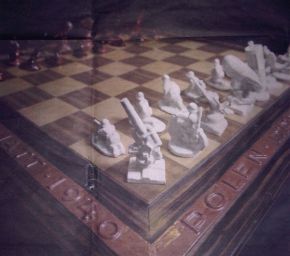
Nazi Chess Set in the Max Euwe Museum
After the tour of the museum, we were shown into the library, which had a collection over 10000 chess books inside. As there are so many different chess books, from opening, to endgame, to strategy, to biographies, etc., many keen chess players often come to this library to study. Also in this collection is one of the oldest surviving books on chess, 'The Bishop', by Ruy Loepez, dating back to the 1500s.

Blitz Tournament

A couple of days after visiting the Max Euwe Museum, Tex asked me if I wanted to come to his club to play in a blitz tournament on Thursday night at 8:00pm. By that stage I hadn't had any competitive chess (apart from the few games at his house) for almost two weeks, and so, eager to get my fix again, I replied with the affirmative. I left the house around 7:00, thinking that the two trams I'd need to take should get me there with 5 or 10 minutes to spare. However, I didn't account for the tram I was taking being 25 minutes late. Nor did I account for not being able to find the place when I got there. So when I finally found the place after 8:30, I was expecting to have already forfeited my first two games. But luckily for me they hadn't started yet.

The blitz was done as a 13 round all-play-all, with playing strength ranging from around 1700 to 2300. I've never really considered myself much of a blitz player, but for some reason today I was feeling pretty good. I got to 4/4, expecting I'd be playing Tex, who'd also been winning all his games. We both got to about 6/6 before he lost one game, but we still hadn't played each other. After several narrow escapes and lucky wins, I managed to get to 12/12, and I was paired with Tex (11/12) for the last round. After thinking for too long in the opening and then missing a nice exchange sacrifice he had, Tex beat me fairly comfortably, so 1st place was shared between us on 12/13.

Results sheet
Unfortunately the only prize for coming equal first in this blitz tournament, was the satisfaction of coming equal first in this blitz tournament. But we decided it was necessary to take a winners' photo, just for the record.*

Tex and me (winners are grinners!)

*This was actually the 8th photo we took... I guess that's what late-night blitz does to you.


Comedy show

At the blitz tournament, I had asked Tex what it was like being a stand-up comedian. He said he had only been performing for around 6 months, so it was a relatively new experience for him. But he asked if I wanted to come to a gig he was doing Friday night, which was going to be entirely in English. So before I knew it, I was at the


There were four acts of stand-up comedy altogether - three Dutch comedians and one English. I thoroughly enjoyed all the performances, but I think I understood some of Tex's chess jokes better than the rest of the audience.

After the show I had the luxury of hanging around with some of the comedians and listening to many entertaining stories about multi-functional steam-cleaners, politically-incorrect Australians, and elephant genitals.

Other news

Before I continue going on about myself, I would like to start off this section by congratulating Max Illingworth, who in the First Saturday GM Tournament in Hungary this September became the youngest Australian ever to make a GM norm, as well as the first to make a GM norm before getting the IM title. Max beat all 3 GMs who played (which could also be a record), and placed =1st in the tournament with 7/9 and a performance rating of 2638!

~


After suffering from the many disadvantages of not feeding myself properly during the BDO, I decided that it was important for me to find some wholesome, nutritious food to get me back into good condition. After all:

"The stomach is an important part of the chess master."
Bent Larsen

So I went and got the best food a chess player can possibly eat.


But unfortunately, the human-being part of me decided against having only chess-piece chocolate biscuits - which no doubt drastically enhance checkmating abilities - for breakfast, lunch and dinner. So I went and bought a large range of ingredients, which I used to cook up my best meal yet:

Fried rice (already half eaten, believe it or not)

On my last full day in Holland, I went to the Rembrantplein, walked around some scenic areas, bought some souvenirs, and took a canal cruise to finish off a very relaxed and enjoyable day.

Seeing the Statue of Rembrandt at Rembrandtplein

Cruising the canals

And swimming the walking the canals

Having the opportunity to visit and enjoy spending time in one of Europe's most famous and exciting of cities was something that I came to appreciate a lot more during the final two and a half weeks I spent there - and I'm sure I will continue to appreciate it once I am back home, working, and attending my first year of uni. Now that it's time for me to leave Amsterdam, I hope that I will enjoy my experience in Hungary, and be able to come back to Amsterdam in the future.

Maybe even next year...


"Hear that, Mr. Anderson? That is the sound of inevitability."

I'm writing now from Kecskemet in Hungary, and I am about to experience my first ever GM tournament. The Kecskemet tournament and the better-known First Saturday tournament take place each month in Hungary, with the latter being held at the start of each month in Budapest, and the former during the second half, taking place in Kecskemet (a city about 90km south-east of Budapest). My first round begins tomorrow at 3:00pm (11:00pm AEST), but unfortunately there is no website for this event, and nowhere online (at least, not that I've found) to check the results. However, I will be posting regularly during this tournament to keep you informed on how it's going. Until then, I feel it is only appropriate to finish this the way I started.

Adios, Amsterdam! And hopefully historical Hungary has hundred heavenly happenings happening half-hourly. Haha.


Wednesday, 27 July 2011

Dutch Open 2011 - Rest day, Day 6 & Day 7

"Oh, prince, sacrifice your rooks, leap with the bishop and save your Dilaram"
Dilaram uttering the words which helped her husband, Prince Murwadi, find the winning combination in a game he had wagered his wife, Dilaram, as stakes
(7th century)

A shot of our cabin

Yesterday (24th) was the rest day at the halfway point of the Dutch Open. Although we planned to take advantage of some of the sports and activities on offer at our accommodation, the weather did not comply and apart from trekking out for dinner with our umbrellas, we spent the day indoors. Compared to the two tournaments in Philadelphia with double round days, this one has been much more enjoyable chess-wise, as there is ample time to prepare (especially with the organizers being impeccably organized, e.g. posting pairings up right after all games have finished), and the atmosphere is more relaxing. 

by Moulthun
Round 6

Not a good day overall, as I drew with a 2300 FM from a position of strength while both Andrew and Junta lost to their GM opponents (Andrey Vovk and Daan Brandenburg respectively). Andrew was playing White and after reaching the very familiar Four Pawn's Attack variation of the King's Indian Defense, he dropped a pawn in a tactical finesse and went on to lose. Junta had a hard time trying to maintain the balance right from the opening and Black quickly got the upper hand going on to convert convincingly. It is unlikely, that we will see much of the double fianchetto from him again during this tournament, and the ones to follow.

I was Black this round, and after some slight move-order inaccuracies, quickly found myself with a slightly worse position from the opening. It was not until the 20th move that I finally managed to comfortably equalise. At this point I was hoping to end my solid, but rather dismal streak of 0 wins against higher rated opposition within the last 3-4 tournaments. The mentality of drawing as Black and winning with White doesn't always seem to cut it in big open tournaments, where no result is guaranteed and every half point is crucial with so little rounds. The following position was reached after the White's 40th move in the game, we both had about 2 minutes left to play our 40th move and gain an extra half hour. Shortly before this my opponent calmly offered a draw, but favouring my chances I decided to make an interesting exchange sacrifice. Objectively this seems best, but I later misplayed the attack and allowed a nice counter-sacrifice creating a rather intricate perpetual check.

Reiner Odendahl (2375) - Moulthun Ly (2369), Dutch Open (6.12), 25/7/11

40...Rxf2! 41.Kxf2 Qxd4+ 42.Kf1 Qe5 43.Kg2 h5 44.Qc2 g4 45.Be2 Bh6 46.Rd1 d4 47.Bc4 Bd5+ 48.Kf1 Kh7 49.Re1 Be3

50.Rxe3! dxe3 51.Bxd5 Qxd5 52.Qc7+ Kh6 53.Qf4+ Kg7 54.Qc7+ Kh6 55.Qf4+ Kg7 56.Qc7+ Kf8 57.Qb8+ Kf7 58.Qa7+ Kf8 59.Qb8+ Ke7 60.Qa7+ Kd6 61.Qb8+ Kd7 62.Qa7+ Kc8 63.Qa6+ Kc7 64.Qa7+ 1/2-1/2

So the run of draws continues for me, but at least I can say I didn't give this one in too early.

But the afternoon was not yet over, after our games we were lucky enough to be tagged along to play in a fun little 6-a-side soccer tournament with some Dutch chess and soccer players.

The competition was set up in a way as to include 10 teams, with some teams comprised of chess players, and a few from the host soccer club (soccer players). Each would play four games in the qualifying rounds, the games being 10-15 minutes in duration on a half-field pitch with netted goals, with the top couple from each pool qualifying to the knockout stages. Game 1 was the first indication that neither us nor our opposition could be taken lightly and this was not going to be some kick around the park. In saying that we narrowly won the game 1-0, but this was a sure sign that games would only get tougher from here on in. The rain only hours before had the field still damp, making running all the more difficult. In fact I had the hardest time staying on my feet slipping several (proofreader edit: many) times, missing some golden opportunities.

During our second game, our team quickly managed to take the lead but this was short-lived. In our half their right winger had turned me inside out and put a immaculately placed shot into the back of the net. With only a few minutes to go, they ran through our defence once again to score the winner. After only drawing our next game 1-1 and then losing our fourth game to a soccer team, our hopes of making to progress to further games was sunk.

However, to our amazement it transpired that all but one team from each pool make it to the next stage, with chess and soccer teams in their own pools, winners of each playing in the grand final. We won our chess semi-final game quite comfortably with a splendid goal (slotted into the bottom left corner with pure class) from Andrew!

One of our games in action

The finals saw us have to face the very same team from our group matches which beat us 2-1. On this occasion everyone played far more cautiously, moving up and down as a cohesive pack. With some luck and great defense we managed to keep it a scoreless game at full-time. This meant a good old-fashioned penalty shootout was in order. Junta seemed the most excited to relive his treasured childhood footballing moments from the penalty area. And it was only one week ago that we were in similar excitement, when Japan won the Women's Football World Cup from the same situation. Anyhow, after several brilliant put aways and mis-kicks under pressure, it seemed we were running low on kickers and after both Junta and Andrew (5th and 6th kickers) scored their shots and my opposing kicker missed, we were tied 4-4 with me the only one left of the field players to kick from the spot.

Andrew slotting in his penalty with his sheer class:


An excellent chance to score the winner and obtain eternal glory on the pitch. But the follow-through was far from impressive, not really troubling the keeper with a too-slow floater to the left post. After that we all began to crack, and after an epic series of hits and misses (with dozens of chanting spectators) it finally ended 7-6 with us narrowly missing out.

The team (and supporters) after the finals

Round 7

This was a very pleasant round for everyone, winning quite comfortably to add an extra point to their tally (our first 3-0 day). Andrew especially had a very nice game, sacrificing his bishop for an attack and finishing things off with his sheer class. Tomorrow I am paired with my fourth GM opponent Deepan Chakkravarthy, while both my compatriots Junta and Andrew have the really unlucky task of facing each other in the penultimate round. Not even pleads to the tournament organizers were able to change this unfortunate pairing.

(show chess board)(hide chess board)

With 2 rounds to go, the top of the table is fiercely contested, with no less than 5 GMs (Turov, L'Ami, Fier, Yuri Vovk and Georgiev) on 5.5/7, followed by Andrey Vovk on 5, 8 GMs/IMs + Moulthun on 4.5/7, and 15 players on 4/7. Moulthun's game against Deepan will be on a live board (9pm Sydney time).

Saturday, 23 July 2011

Dutch Open 2011 - Days 3 & 4

The round under way
"...no one on earth has solved it unless he was taught by me. I have never learnt that there was anyone before, for if anyone had solved it, he would either have written down the solution, or have taught it to someone else.
This is the word of as-Suli."
as-Suli, the best player in the world around 900 AD, on a problem he composed

Round 3

A bad day for us, scoring just 0.5/3. Junta's opponent GM Vladimir Georgiev played a nice exchange sacrifice right after the opening which quickly developed into a crushing attack; Moulthun lost to GM Yuri Vovk after sacking the f-pawn for a single 1-move tactic which simply failed, and he was losing in each and every conceivable endgame; and Andrew sacrificed two pawns in the opening for positional compensation in his game, but he could only manage a draw in the end.

Polysport, where we are staying is a sports catering/accommodation place, and there are tennis courts, a volleyball net, hockey fields and a tennis table literally right outside our cabin, among others.

Non-chess play of the day: Ly-Brown

Round 4

Moulthun beat his younger opponent weaving a mating net, getting to 2.5/4; Junta played his third GM in a row, where he seemed to have two promising attacking moves at move 40 as White (with many observers watching in anticipation), but blundered a piece instead and lost (now on 2/4); while Andrew (also getting to 2/4) scored the chess play of the day (week), his opponent after the game sportingly telling him that he hoped the game wins a prize.

22.Qxe4!! and the next diagram is Andrew as White to play move 28:

He found a very nice forced mate in 9 - see if you can do the same (solution below can be seen by highlighting all text).

28.Re8+ Kg7 29.Rxf7+ Kh6 30.Nf5+! [30.f5+ Kh5 31.Rxh7+ Kg4 32.Re4+ Rxe4 33.h3+ Qxh3] 30...Kh5 [30...gxf5 31.Re6+ Kh5 32.Rxh7+ Kg4 33.Rg6#] 31.Rxh7+ Kg4 32.Nh6+ Kh4 33.Ng8+ Kg4 34.Nf6+ Kf5 35.g4+ Kxf6 36.Re6# 1-0


(show chess board)(hide chess board)


For Round 5 tomorrow (9pm Sydney time), Moulthun's game will be shown live.

Monday, 18 July 2011

Getting Ready for Dieren

By Moulthun

"It is an honour for you to be here; ordinarily I converse only with my greyhounds."
(Mir Sultan Khan's Master: London 1933)

For the past two weeks since the conclusion of our America trip, Junta, Andrew and I have been doing our best to camouflage ourselves as Dutch locals. However, no matter how hard we tried there is always something which gives us away. From our obvious lack of Dutch (Junta has been here for almost three weeks and still cannot say a single word of Dutch correctly), to the apparent foreign english accents.

During the first few days of arriving in Amsterdam, I fell ill to an infection, which stole almost a week off our travel plans. It seemed to have happened after competing in an interesting Blitz Chess/Table tennis tournament, which consisted of 7 rounds, with 4 games of table tennis and 1 games of blitz chess 5 0 against each opposition. Although my blitz almost landed me a 50% score overall, my table tennis was far from impressive. In fact I thought I would have a chance if I didn't get paired with a competition player, but I knew I was going to suffer when I realized my racket grip has hardly ever been seen before. Sadly I didn't manage to win a single game, although I had many close calls which I suspect were my opponents toying with me as payback for the blitz. It seems the changes from physical to mental exercise was extremely straining and definitely tested my ability to focus. But it was a unique and very enjoyable experience, perhaps one day we will see other sports being combined with chess.
Me vs (GM) Robin Swinkels
Since then we have done the typical day trips, absorbing in what the rich city and picturesque countrysides of Holland have to offer. Resting between days, to enjoy local activities within the park and publicly provided sporting areas. Chess preparation has been added in here and there but nowhere near as much as what was intended. Tomorrow though, all three of us will take a short trip to Dieren to compete in the Dutch Open starting on the 19th July. In the meantime we pack our bags and try to cram every last bit of chess knowledge we can possibly hold.
Although we all have big ambitions, we can only wait and hope if any of them can be fulfilled.